A few weeks ago, a cross-border shipment from Nigeria to Togo offered a clear illustration of one of the most persistent challenges facing African logistics.
On paper, the movement looked straightforward. The cargo had been packed. The carrier had been engaged. The destination was confirmed. The customer was waiting. Like any international shipment, the usual logistics considerations were expected: scheduling, customs clearance, and coordination among multiple stakeholders.
What became immediately clear, however, was that transportation itself was one of the least demanding parts of the process.
The truck was delayed. Documentation became a maze. Customs charges turned out significantly higher than anticipated. Communication slowed because of language differences, forcing the use of translation applications simply to resolve operational issues. Then came payment, and that became a project of its own.
Traditional cross-border payment channels could not support the transaction from Nigeria to Lomé. Several fintech platforms appeared promising until their documentation requirements became disproportionately burdensome. Others offered exchange rates that made the transaction commercially unattractive. Eventually, cryptocurrency became the only practical option.
At that moment, a deeper reality stood out.
The biggest obstacle was not moving goods from Nigeria to Togo. The biggest obstacle was coordinating dozens of disconnected systems that should have worked together.
This experience reinforces a belief that many logistics professionals across the continent have long held:
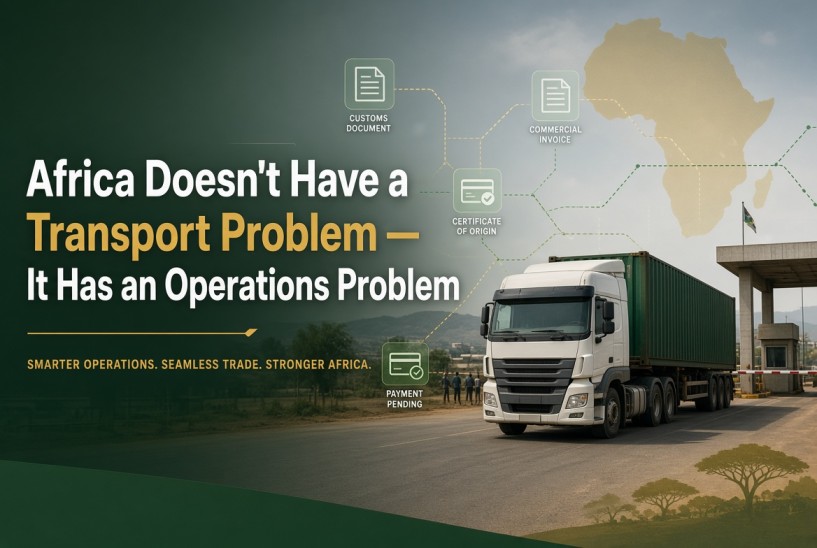
Africa does not primarily have a transport problem. Africa has an operations problem.
More precisely, the continent’s greatest challenge is not a lack of operational capability. It is a lack of operational integration.
The Reality of Fragmented Systems
Across Africa, we have transport operators, ports, customs authorities, freight forwarders, financial institutions, regulators, technology providers and payment platforms. Each performs an important role. Yet too often these systems operate independently rather than as one coordinated trade ecosystem.
The result is friction. And in logistics, friction is expensive.
When discussions about African logistics arise, the conversation almost always centres on infrastructure. We need better roads. We need modern railways. We need deeper seaports. We need more cargo airports. These investments are undeniably important. Efficient infrastructure lowers transportation costs, improves connectivity and supports economic growth.
But infrastructure alone cannot compensate for fragmented operations.
A truck travelling on an excellent highway can still spend days waiting because documentation is incomplete or duplicated. A modern port can lose efficiency when multiple government agencies perform overlapping inspections. A shipment can arrive at the border on schedule yet remain stranded because payment systems are incompatible or trade documentation cannot be verified seamlessly. Goods can physically move thousands of kilometres, only to be delayed by information that cannot move just a few metres between institutions.
In each of these situations, transportation worked. Operations failed.
What the Data Tells Us
This distinction is supported by the World Bank’s Logistics Performance Index (LPI), one of the most widely recognised measures of logistics performance globally. The LPI assesses countries across six dimensions: customs efficiency, infrastructure quality, ease of arranging international shipments, logistics competence, tracking and tracing, and timeliness.
Notably, four of these six dimensions relate primarily to operational effectiveness rather than physical transport infrastructure. The message is clear: successful logistics depends as much on coordinated systems, institutions and processes as it does on roads, ports and railways.
Every delay in the supply chain carries a cost, not only a financial cost, but also operational cost, opportunity cost, customer confidence, business reputation, and working capital. In practice, very few supply chain disruptions are caused solely by a lack of trucks or warehouses. More often, they are caused by disconnected processes, inconsistent regulations, manual documentation, fragmented technology and poor coordination between organisations.
The irony is that businesses frequently invest millions in physical assets while neglecting the operational systems that determine how efficiently those assets perform. The result is predictable: more vehicles, more warehouses, more infrastructure, but not necessarily better logistics.
AfCFTA and the Opportunity Ahead
The African Continental Free Trade Area (AfCFTA) represents one of the most ambitious economic integration projects in modern history. Its vision is to create a single African market where goods, services and investments move more freely across borders.
The scale of the opportunity is enormous. According to the African Development Bank, intra-African trade accounts for only about 15% of Africa’s total trade, considerably lower than comparable levels in Europe and Asia. While production capacity and industrialisation are important factors, fragmented logistics systems, inefficient border processes and disconnected payment infrastructure remain significant barriers to regional trade.
Lower tariffs alone will not unlock intra-African trade. Trade moves at the speed of its slowest operational process. If customs procedures remain inconsistent, if documentation remains largely manual, if payment systems remain fragmented, if language barriers continue to slow coordination, and if regulations differ significantly across neighbouring countries, businesses will continue to experience unnecessary friction regardless of how much infrastructure is built.
The next decade must therefore focus on making trade easier to execute, not merely easier to imagine.
What Needs to Change
Governments have a critical role to play. Priorities should include digitising and harmonising customs procedures across African borders; expanding single-window systems that allow traders to submit documentation once rather than repeatedly; improving interoperability between national payment systems; investing in digital trade infrastructure with the same urgency as physical infrastructure; accelerating the practical implementation of regional trade agreements through consistent policies; and encouraging multilingual trade support and technology-enabled communication.
Recent African Development Bank analysis continues to identify fragmented payment systems and limited financial integration as key obstacles to regional trade. Moving money across African borders should be as efficient and predictable as moving goods. Until both systems evolve together, businesses will continue to absorb avoidable costs that ultimately reduce competitiveness.
Infrastructure should remain a priority. But infrastructure without operational integration simply moves inefficiency from one location to another.
Businesses must also play their part. Many organisations still rely on disconnected spreadsheets, paper documentation, manual approvals and siloed departments. Operational excellence is no longer optional; it has become a competitive advantage. Companies that will lead the next decade are those that invest in process standardisation, supply chain visibility, digital documentation, data-driven decision-making, cross-functional collaboration and continuous process improvement.
The objective should not simply be moving products faster. It should be reducing friction at every stage of the journey.
ATLSF’s Perspective
At the African Transport & Logistics Supportive Foundation (ATLSF), we engage daily with the realities faced by transporters, drivers, freight forwarders and operators across the continent. We see the cost of fragmented systems in delayed deliveries, inflated expenses, eroded margins and lost opportunities.
This is why our advocacy focuses not only on better infrastructure, but on the systems that make infrastructure work: clearer processes, better coordination between institutions, stronger representation of logistics professionals in policy conversations, and practical solutions that reduce friction on the ground.
A successful delivery is not always an efficient supply chain. Success should not depend on improvisation. It should depend on systems.
The strongest supply chains are not necessarily those with the most trucks, the largest warehouses or the newest ports. They are the ones where information flows as smoothly as products, payments move as efficiently as vehicles, and institutions work together instead of operating in isolation.
That is what creates resilience. That is what reduces cost. That is what attracts investment. And ultimately, that is what improves the customer experience.
The Way Forward
The ambition behind the African Continental Free Trade Area extends far beyond lowering tariffs. Its success depends on whether African businesses can move goods, information and payments across borders with speed, predictability and confidence.
The next decade will not be won by the countries that build the most roads. It will be won by those that build the most connected systems.
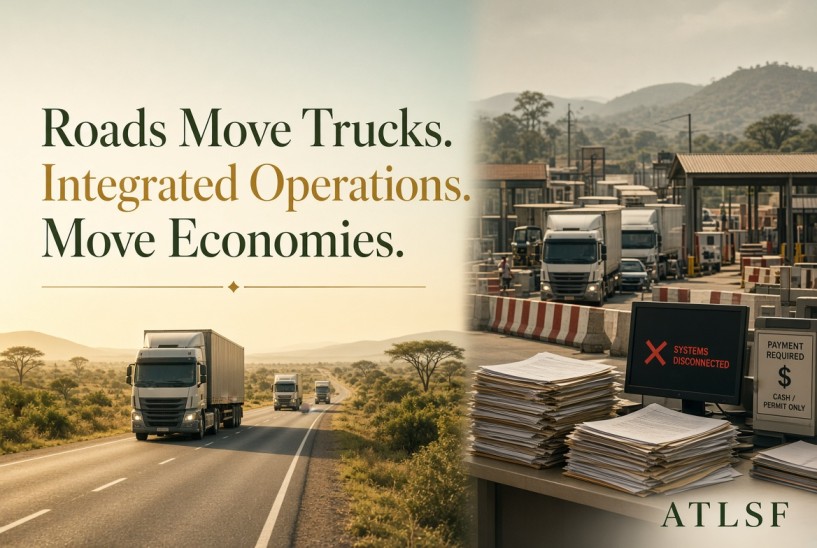
Roads move trucks. Integrated operations move economies.
If Africa is to become a truly competitive trading bloc, our greatest investment must not only be in infrastructure, but also in the systems that make infrastructure work.
Because the future of African trade will not be defined by how far our goods can travel. It will be defined by how little friction they encounter along the way.
What operational challenge is costing your business the most?
Share your experience with us. Your voice helps drive the change we need.
Contact ATLSF
Phone: +234 915 595 2144
Website: www.atlsf.org
Together we move Africa — sustainably.