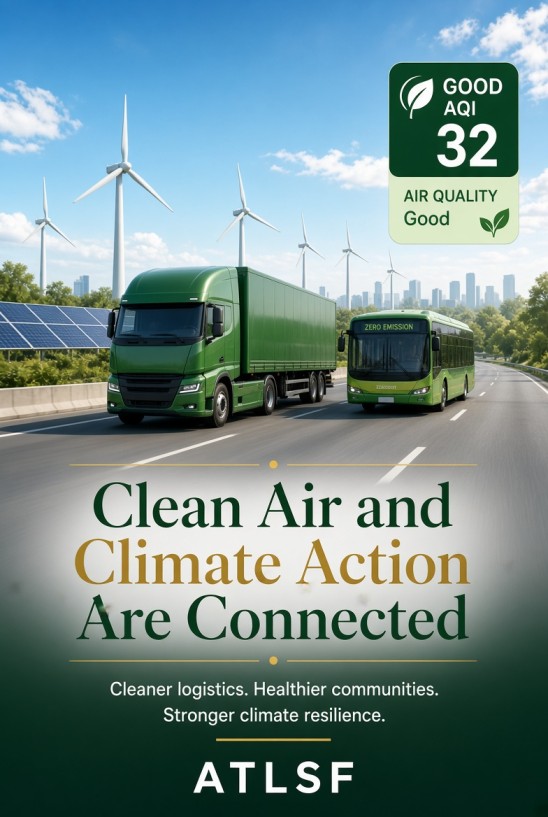
A few days ago, the world marked the seventh International Day of Clean Air for Blue Skies on 7 September 2026. The global observance, led by the United Nations Environment Programme and the Climate and Clean Air Coalition, focused on a powerful and often overlooked truth: clean air and climate action are not separate conversations. They are two sides of the same problem.
We have long treated air quality and climate change as distinct issues. One discussion centres on particulate matter, haze over cities, and respiratory health. The other focuses on carbon dioxide, gigatonnes of emissions, and long-term planetary warming. Yet both emerge from the same fundamental source, the way we produce and use energy.
Every particle of soot and every molecule of carbon dioxide largely comes from the same combustion events. A diesel truck idling at a border post, an inefficient generator powering a warehouse, a heavy-duty vehicle stuck in congestion, or an outdated industrial furnace, each simultaneously releases greenhouse gases and the pollutants that make air genuinely difficult to breathe.
The Scale of the Challenge
The numbers remain sobering. According to the World Health Organization, air pollution is linked to roughly seven million premature deaths every year. The overwhelming majority of the world’s population still lives in places where air quality fails to meet WHO guidelines. This is not a distant or abstract problem. It is a daily reality for communities living near major transport corridors, ports, truck parks, and industrial logistics zones.
Inefficient, carbon-intensive energy and transport systems do not merely sit next to this problem, they manufacture it. Cleaner energy and more efficient logistics are therefore not optional add-ons. They are central to both cleaner air and meaningful climate action.
Why This Matters for Logistics
In the logistics and transport sector, the connection is especially clear. The movement of goods relies heavily on combustion engines, long hours of operation, and complex networks of roads, ports, and warehouses. When vehicles are inefficient, routes are poorly optimised, or systems are fragmented, the result is more fuel burned, more emissions released, and poorer air quality along the corridors where people live and work.
A truck that arrives on time but spends hours idling because of documentation delays or operational friction does more than waste time and money. It continues to emit pollutants into the surrounding air. Congestion, inefficient fleet management, and outdated equipment all compound the problem.
This is why operational excellence and climate performance cannot be separated. Better coordination, digital documentation, route optimisation, and reduced waiting times are not only good for business efficiency, they are also practical clean-air measures.
Technology and Systems as the Pathway
Recent data offers a more encouraging signal. While energy-related carbon emissions reached new highs in 2025, power sector emissions have shown signs of stabilising in many regions even as electricity demand grows. This decoupling is driven by the rapid expansion of renewable energy, improvements in the carbon intensity of electricity, and growing electrification.
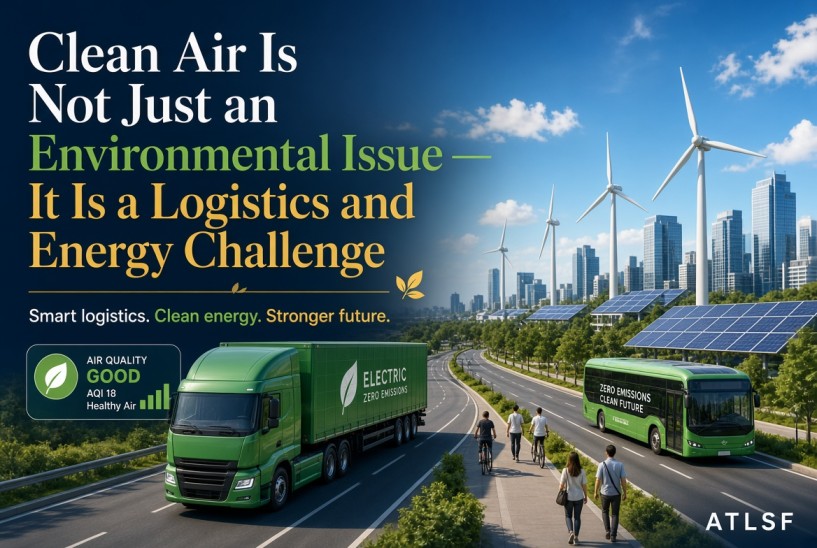
For logistics, the implications are significant. Renewable power can support cleaner warehouses and cold-chain facilities. Electrification of certain vehicle segments, where feasible, removes tailpipe emissions from urban and peri-urban air. Better data systems and operational integration reduce unnecessary fuel consumption. Storage and smarter grid connections help make cleaner energy more reliable for industrial and logistics users.
None of these solutions works in isolation. Their cumulative effect, however, is powerful: lower emissions, cleaner air near the places where people actually live, and more resilient supply chains.
The Co-Benefits Are Real
When logistics systems become cleaner and more efficient, the benefits land on multiple lines of the same balance sheet:
- Reduced fuel costs and operational waste
- Lower exposure of drivers and surrounding communities to harmful pollutants
- Fewer disruptions caused by climate-related impacts
- Stronger compliance with evolving environmental and health standards
- Improved long-term competitiveness
Clean air, in this sense, becomes a reliable indicator of how efficiently energy and logistics systems are evolving. It is both a public health outcome and a performance metric.
ATLSF’s Perspective
At the African Transport & Logistics Supportive Foundation (ATLSF), we see these connections every day through the experiences of transporters, operators, and communities along major corridors. Air pollution and climate impacts do not stay in reports, they appear as health pressures, higher operating costs, damaged infrastructure, and reduced reliability.
This is why our advocacy continues to focus on practical, integrated solutions: climate-resilient infrastructure, cleaner and more efficient operations, reduced waste along transport routes, and stronger coordination between systems that too often work in isolation.
We believe the logistics sector has both a responsibility and an opportunity. By improving how goods move, we can simultaneously improve the air people breathe and strengthen the resilience of the supply chains that economies depend on.
Looking Ahead
The International Day of Clean Air for Blue Skies is a useful annual reminder, but the real work continues long after the observance ends. The sharper question is not simply how we clean the air, but what combination of technology, capital, policy, and operational discipline will allow industry and logistics to grow while systematically reducing the environmental and health costs of that growth.
Clean air is not solely an environmental objective.
It is a measure of how intelligently we design and manage the systems that power and move our economies.
At ATLSF, we remain committed to advancing that agenda, supporting operators, engaging policymakers, and promoting solutions that deliver cleaner air, stronger climate resilience, and more efficient logistics.
Cleaner logistics. Healthier communities. Stronger climate action.
Together we move Africa — sustainably.
Contact:
+234 915 595 2144
www.atlsf.org